

Heidi VanDerveer enters her 15th season at the helm of UC San Diego women's basketball, having built the program from a Division II powerhouse to a Division I threat. During her DII years, she racked up four consecutive California Collegiate Athletic Association (CCAA) Coach-of-the-Year honors (2016-2019) and a program-record 30-game winning streak in 2018-19. When UC San Diego made the jump to Division I, VanDerveer masterfully guided the Tritons through the transition, resulting in a Big West Championship in the program's first year of tournament eligibility. She then backed it up with a second-straight title in 2026, with each championship earning the Tritons an automatic NCAA Tournament berth.
Before arriving in La Jolla, VanDerveer built a resume spanning both the college and pro ranks. She served as head coach of five different programs including Eastern Washington, University of San Francisco, Sacramento Monarchs, Occidental, and the WNBA's Minnesota Lynx. With USA Basketball, she served as a scout for the gold medal-winning 2008 Olympic squad. She got her start as a graduate assistant under Pat Summitt at Tennessee, helping the Lady Volunteers to a national title in 1987.
Her UC San Diego tenure remains her longest and most decorated as head coach, with seven NCAA Tournament appearances, five conference tournament titles, and a coaching record of 300-147 (67.1%).
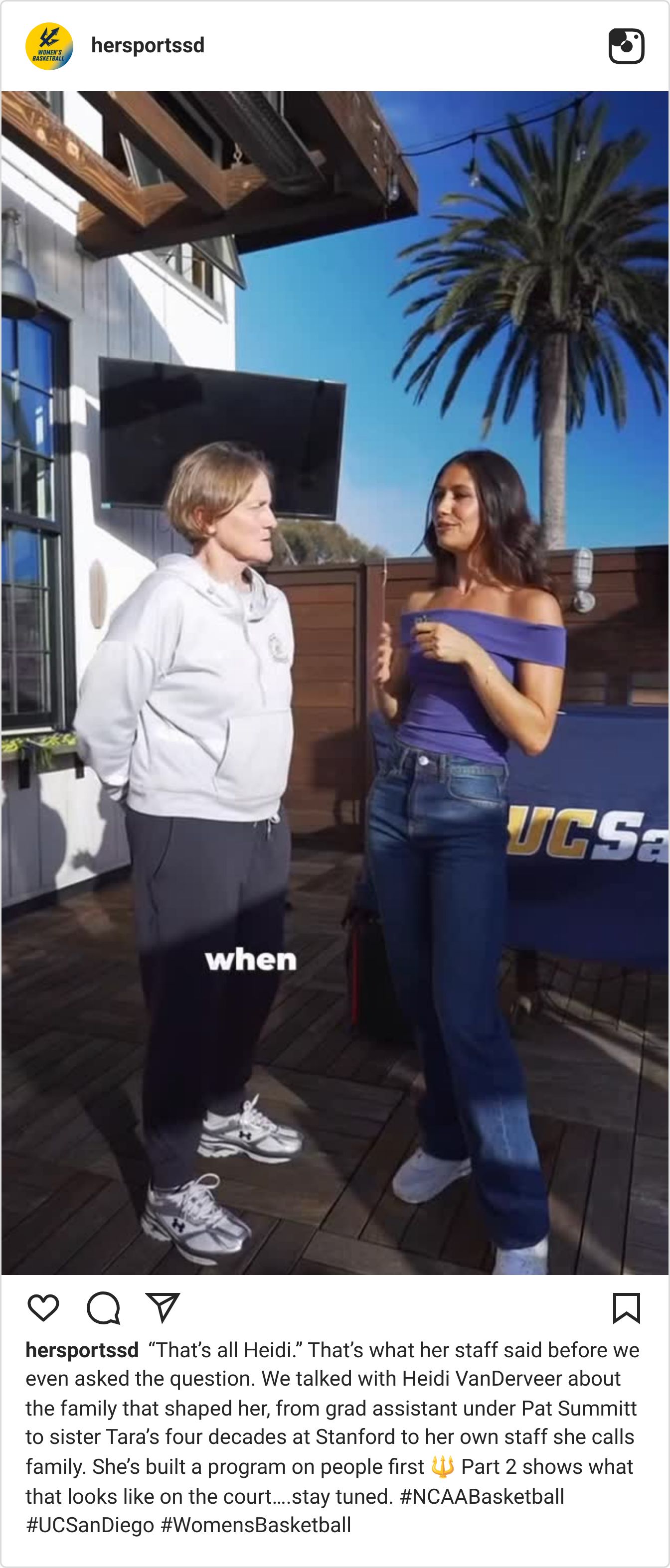
Jourdan Ziff, co-founder at Her Sports, had a chance to talk with Coach VanDerveer in August at an event highlighting the head coaches of UC San Diego’s men’s and women’s basketball. Below, check out the conversation.


UC San Diego’s head basketball coach Heidi VanDerveer and Her Sports San Diego’s Jourdan Ziff at UC San Diego Basketball’s Coaches Road Show in August.
I am talking with Heidi VanDerveer, the UC San Diego women's basketball head coach. Now, Heidi, I was actually just talking to your staff last week about the growth and success of your program, and pretty quickly, your staff members said, ‘That's all, Heidi.’ How does it feel to be recognized like that by your staff and your peers?
Well, I think it's really humbling. But honestly, we win with people. We've got great players. We have great people. My staff is fantastic. I put them up against any staff in terms of just the way they care about people, the way they coach people. The young women on our team are really fortunate, as am I, to have them.
In talking about a group of people around you, you started as a grad assistant under Pat Summitt, your sister Tara, who coached at Stanford for almost four decades. What have you brought from that elite coaching community to your approach?
I think that you really try to be your own personality, and then you can be consistent. Obviously, I take a lot of things from Pat: being fair, being consistent, being disciplined, having very high standards. I think Tara really taught us to have, as a family, she's the oldest, and I'm the youngest, so [she taught] our siblings, just to be the best version of yourself that you can be every day. Brian Agler. I mean, I learn a lot from my staff. I mean, Vanessa Nygaard, PhyNique Allen, Miranda Seto, Alex Young. I mean, they're just great. We share information, we challenge each other, we support each other, just like a family.
And that has expanded even beyond the collegiate level. You coached in the WNBA and worked with players like Sue Bird, Diana Taurasi. So, what have you brought from that professional level of experience to the collegiate level?
I think being a pro. I think that pros are, you know, they're next level. Not just in terms of their skill, but in terms of their preparation, in terms of the expectations that they have for themselves and their team. And we try to have really high standards of, you know, work and effort and just energy and attitude and the things that are not just skill. You know, so at the highest level where we want to play, you know, you have to have a lot more of the intangible things, and I think that's what pros do. They have tremendous intangibles.

Credit: Erik Jepsen / UC San Diego Athletics
I think part of that is paying off. You've brought a Division II program to back-to-back Big West titles and NCAA appearances within those first two years of eligibility. So when you joined UC San Diego in 2012, is that the level of basketball you imagined?
Well, I think we always have recruited the best. We've always recruited the brightest, whether we were Division II or now Division I. I think that you know UC San Diego from the top, from the chancellor to our athletic director Andy Fee, to our coaches, to our scholar athletes. Really, it's a culture of excellence, and so I think the expectations that we have for our team to compete at the highest level, that's what UC San Diego is. It is an elite academic institution where a lot of people do various things at the highest level.
Getting into the weeds a bit of even this upcoming season, you talk about those expectations. Is there a specific stat or even sign that you check in on as the season progresses to make sure you're maintaining the level and the goals that you want to get to?
I think we have an overarching goal to compete for Big West Championships and in the future WCC Championships. But really, we focus on … it might be coach speak, but the process. … The process is just showing up every day and giving whatever your best effort is. And we ask that of our team. We ask that of our staff. And if we can do that, then the results, the stacking days, will eventually lead to however you want to define success. But being competitive for Big West Championships or for you know going in the NCAA tournament.

Credit: Derrick Tuskan / UC San Diego Athletics
Talking about that process, we're so excited to follow. And you mentioned you're heading into that last year of the Big West before big conference realignment. So, how are you hoping this next team and this season is remembered?
I just think just a special one. I think that you know we have wonderful leadership with our seniors, Erin Condron, Rosa Smith, Dymonique Maxie. We have an influx of energy and youth, and they work hard. They compete. They want to do really well. And if we can be remembered as a team that you know just left everything we had on the floor, and we did it together, then I like our odds against anybody.
Listen to Part I of the Interview here:
Part 2 coming soon!


