Safe at Home
Whitney Benjamin has experienced a myriad of successes in her life. From winning a softball national championship at UCLA to playing professionally in Italy, working at the 2010 Winter Olympics with Lululemon, and building a successful coaching career, Benjamin has no shortage of adventures from which to feel at home. But when asked what the current chapter of her life would be titled, she shared that only now does she feel wholly safe and at home. The feeling did not come from one of the many achievements in her resume. Instead, it came from the very simple yet difficult task of understanding herself.
“My current chapter would be… I’m home. I’m safe at home.”
When learning about Benjamin, most people will expect a story of childhood inspiration, collegiate success, and an illustrious career in the world of women’s sports. On the surface, that does describe her achievements. However, like most people, there is another layer underneath the accolades. Benjamin is a daughter, a wife, a mother of three, and a passionate advocate for athletic mental health awareness. When asked about her life today and what she is most proud of, the answer isn’t anything related to athletics. She talks about her kids, feeling at peace, being present, finally understanding herself and her own mental health journey. This begs the question: how did someone who achieved so much spend so many years searching for herself?

Whitney Benjamin in her college career at UCLA. Photo courtesy of Whitney Benjamin.
Tony Gwynn’s Last At Bat
Benjamin grew up in East County and, like many kids, fell in love with sports.
“I really threw myself into sports, particularly baseball and softball. That was my saving grace,” said Benjamin.
Benjamin described her childhood as being a bit of a tomboy, climbing trees with her best friend, and having a wonderful family. However, she describes it as a bit turbulent, with some loss in the family and some mental health struggles. Benjamin’s response was to throw herself into the games she loved. Like many San Diego kids at the time, Tony Gwynn was Benjamin’s childhood hero. At just 10 years old, she witnessed his last at bat at Qualcomm Stadium with her father.
“After the game, he went around the entire stadium and shook everyone's hands,” Benjamin shared. “My dad and I waited there for probably an hour just to shake his hand. Even thinking of that memory, I get tears in my eyes because of what he meant to me and what he meant to this city.”
Benjamin started her softball career at Rancho Bernardo Little League, and through playing travel ball she developed a special relationship with her father. It started with a connection to fellow left-handed batter Tony Gwynn and was continued with her dad’s support in playing the sport she loved. Three-hour drives and early mornings did not deter her commitment to the game, and she did not play for any reason other than for the love of the game. It was fun.
At 14 years old, her travel ball coach took the team to watch a collegiate tournament at the Poway Sports Complex. The coach pulled Benjamin aside and told her, “‘Whitney, you could play here someday. You could play for one of these teams.’” She was shown her future, her possibilities, and her journey to a collegiate athletic career began. All of her little league games and backyard wiffle-ball sessions with her dad led to something bigger than herself. Who she was, what kind of athlete she wanted to be, and what sports meant to her personally further developed entering college, when the dream started to become reality.
The Cost of Excellence
It isn’t uncommon to struggle a bit as a college freshman. It’s a rough transition from high school socially, emotionally, and academically. Benjamin’s first couple of years in college were no exception. The pressure and struggles were continuous, the sisters she met and lessons she learned were incomparable. An intense recruiting journey and being converted from a shortstop to an outfielder, paired with the death of her grandfather as well as her mom’s best friend, led to both physical struggles on the field and emotional struggles mentally. During this time, Benjamin was also diagnosed with PCOS (Polyendocrine metabolic ovarian syndrome) and rheumatoid arthritis.
When asked if there was anyone at UCLA who changed the trajectory of her life, Benjamin said that it was without a doubt her head coach Sue Enquist. Benjamin described Sue as a “prolific human”, and during her struggles freshman year, Benjamin described sitting in Sue’s office.
“I'll never forget. She looked at me dead in the eye, and she was like, ‘Whitney, you are a leader on this team. I need you. Even if you don't start everyday, girls on this team look up to you for your grades, for your work ethic, for who you are as an optimist. I want you and I need you on this team. I know you don't feel well, and I will personally call all the doctors I need to to get you well. You want to do this?’”
Benjamin was in. Enquist sent her home with resources and information on healthy diets and nutrition, and with these changes she began to feel better almost immediately. Benjamin educated herself during that summer on what her body needed to be at her best, both mentally and athletically. She shared that Enquist championed her through this tough time in her life, and says that any other player who played for Enquist would say the same thing.
“She was such a tough coach,” Benjamin said. “But she held such a high standard for us… Some [coaches] demand respect, but you can't demand respect. You have to command it. And she would command it because we wanted to do well. She also made us learn that we have to do well by, for, and of ourselves in order to actually perform.”
The Magic Behind A National Championship
Winning the College World Series, according to Benjamin, is not only incredibly difficult to do, but she says there is also a certain magic behind it. She says that what she remembers most about the accomplishment is not certain plays, or teammates hitting home runs, though she does have glimpses of those. What she remembers most is how well the team came together, and that it started in the weight room. She shared how her teammates would stand around a squat rack screaming encouragement at one another. Lifting together three times per week and conditioning twice a week early in the mornings, followed by a day full of classes, followed by an afternoon of practice formed a level of connection between Benjamin and her teammates that is difficult to find in other places.
“You just can't fake that type of camaraderie and magic that contributes to a national championship. Talent only gets you so far.” Benjamin said.
A particular anecdote about Enquist’s style of coaching and player/human development that Benjamin shared was one that followed a 3-0 win over a smaller school. The words “drop your bags” are known to many athletes as an instruction to start running laps. For Benjamin and her team, these three words meant start running until someone pukes. And so, the team began running laps despite the intense Fresno heat. Benjamin shared that their way of continuing on was to go down the line of girls and each one told a joke. It didn’t matter how funny or bad, everyone had to tell a joke one by one, and that is how they managed to continue running. She finished the story by explaining that once someone on the team felt like they could puke, the rest of them began cheering her on to do so.

Whitney Benjamin during a game at UCLA. Photo courtesy of Whitney Benjamin.
“Even though it's so vile, it's those moments that make a team great and make them brethren at that point,” Benjamin said. “We're in the trenches together and that shows up later when you're on the [College] World Series stage.”
The Italian Experience Changed Everything
Having majored in sociology and philosophy, a logical next step for Benjamin post-graduation was law school. She had a minor stint at a law firm while studying for the LSATs (the national test that prospective attorneys take to gain entrance to law school), with the idea that she could do something with a law degree that would hopefully land her in the sports management field.
This was when everything changed. Her mother’s best friend and godmother-like figure in Benjamin’s life who had passed away during her freshman year in college, had a son. He passed away almost two years to the day after his mother’s passing. Before Benjamin even had time to grapple with yet another loss in her life, she received an email from an Italian softball team asking her to play.
Benjamin left everything – her law firm, her LSATs, her country, and the life she knew – and went to Italy. There she would find something that would alter her life, start her on the path to discovering her passion, and better understanding herself.
“It wasn't until I was in Italy that I realized how into well being, wellness, and women's bodies I was,” Benjamin said. “The way in which women carried themselves in Italy was just different. It didn't matter what size they were. They just walked with so much confidence and love, and I wanted to do that when I got home.”
The small seed of health and well being that had been planted during Benjamin’s college career, when she was struggling with her diagnosis and learning the best way to take care of herself, blossomed into a passion in Italy. The different view of womanhood she discovered while playing there showed her that she could, in fact, champion other women into living a healthy lifestyle, similar to what Enquist had done for her in college.
“I didn't know what that looked like. I just knew that I wanted to be in a working culture where I could influence well being and young women. And so that led me to Lululemon.”
Benjamin’s corporate time working for Lululemon and the opportunities that arose from that (including partnering with the 2010 Winter Olympics in Vancouver) taught her something else about former athletes in the work force.
“I've always had a different mentality towards work than my coworkers, and I've noticed this in other people I've worked with who [were] also student athletes,” Benjamin said. “We just have a no-BS drive, get the job done. And I think UCLA really taught me that level of resiliency… And that's not really something you can teach in the corporate world. It's like something you learn growing up through athletics.”
The Mental Health Journey: Looking Back
Benjamin’s biggest passion is mental health advocacy. It’s what she focuses on the most in her coaching career now – nervous system regulation, breathwork, and tools that young athletes can use to understand their own headspaces and personal journeys. These are tools that Benjamin did not necessarily have herself, and learning how to understand her own journey took a lot of time.
“I have had a very unique mental health challenge,” Benjamin said. “I'm bipolar, and I didn't know I was bipolar until very, very recently, the last couple of years. So looking back on my athletic career, even my early days at UCLA, I was definitely exhibiting early signs of being bipolar, depression and mania, but I didn't have any resources.”
After a couple of more recent manic episodes, Benjamin credits her three children as the reason she’s fully come back from them. Spending time with her kids is her full priority, and she notes that they keep her grounded. Being where her feet are is Benjamin’s mantra, and right now that means being with her children.
“I work with female athletes and I do hitting lessons now. I keep a very light schedule in protection of my mental health, and also in protection of the time I have with my kids,” she said. “And now I'm fully medicated, I haven't had any symptoms of mania, and I'm in such a great position, but I wish I had known earlier in life what was happening with me mentally, because I think I would have rebounded faster at UCLA, emotionally.”
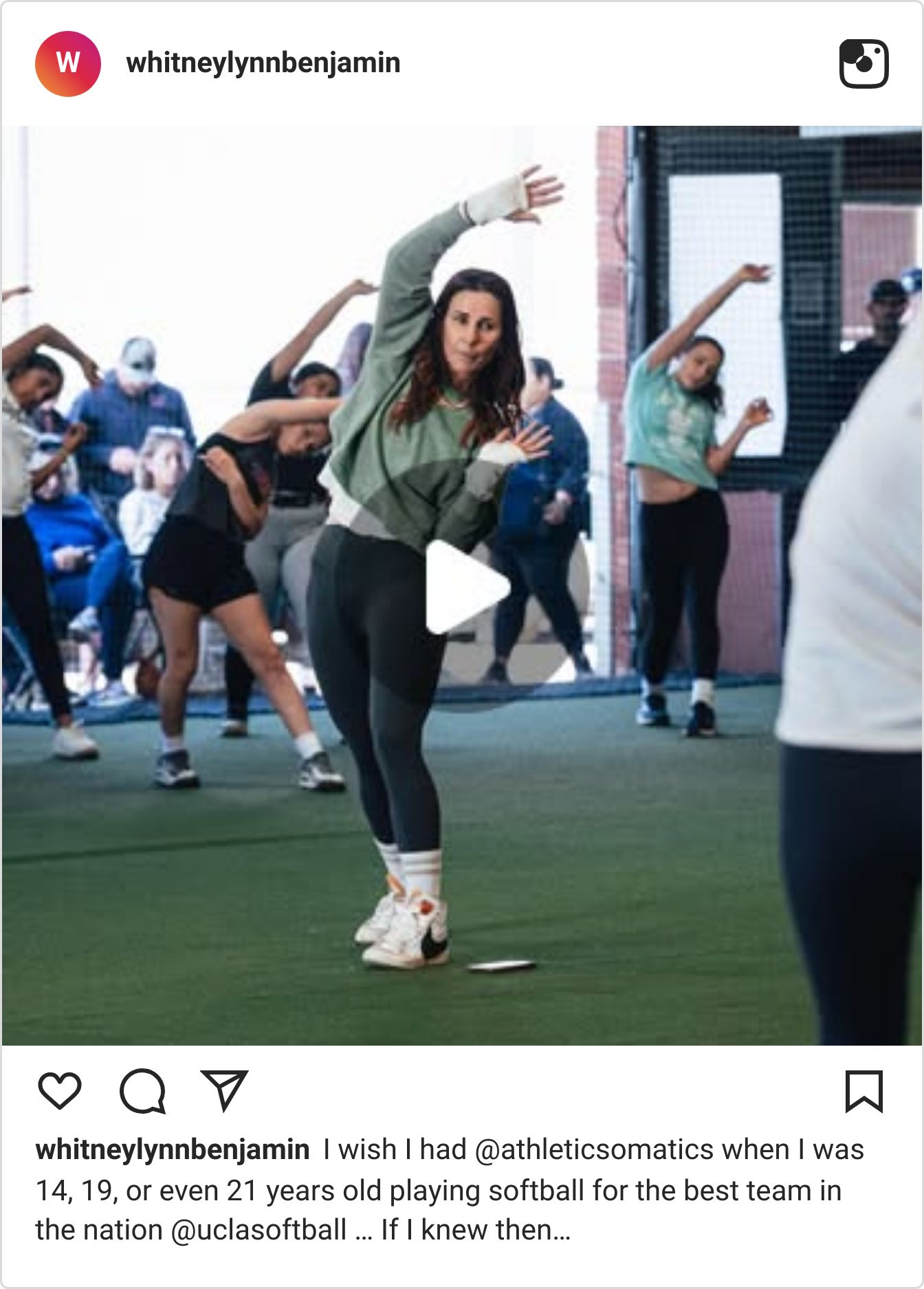
Benjamin is now at a place where she fully understands her own mental health. She is able to take what she’s learned about herself and apply it to her coaching career. Girls age nine and older come to Benjamin not only for hitting practice, but also for mental coaching. She practices breathwork with all her players and helps them be attuned to their bodies. Educating young athletes about their nervous systems, somatics, understanding emotions, and creating a safe environment to manage frustration over a bad game or a rough practice is Benjamin’s niche.
Benjamin’s players as well as her own children are her stability. She teaches the very tools that she needed at a young age. Knowing that she is helping the next generation of athletes reach a point that she was not able to be at in her early career is a rewarding feeling for her, but she does share that there is more work to be done.
“I would like to see more women coaching in all youth sports,” Benjamin said. “I'd like to see more systems where we really support and champion that because I think they need it. Our kids need different points of views and different perspectives and different coaching styles.”

Whitney Benjamin is now a coach for young softball and baseball players. Photo courtesy of Whitney Benjamin.
Benjamin shared that she is often the only female coach at a baseball field. She is currently the only female coach at Point Loma Little League’s Intermediate League, for baseball players ages 11-13. She says that she knows there are a lot more women out there with baseball or softball knowledge, and she urges them to break into that field.
“I think that we as women just have to pull each other along, and I have to personally encourage more women in my life to just get out there and do it,” she said.
Benjamin’s Vision for the Future
Creating a coaching environment in which an athlete is pushed to do their best, but also one where they feel okay discussing mental challenges they might be having is a difficult balance. Benjamin understands this, having been on both the coached and coaching side of it. The one-on-one coaching style she implements makes it easier for her to impact a young athlete’s mentality towards health. She shares that she often talks with her players during hitting practice about whatever may be going on in their lives, where in their bodies they are carrying it, how they feel, and how that projects onto the field.
“If more coaches went through a nervous system training or some sort of somatic training to understand what happens in your nervous system and what shows up, it would go so far to help impact these girls,” Benjamin says.
On a more personal level, Benjamin’s family remains her number one priority. She references her husband, Alex, as the person who helped shape her journey the most, and she says the thing she is most proud of in her life is her children. Feeling safe at home is her current chapter, but that’s not to say there won’t be more chapters. In fact, Benjamin is considering writing a book at some point in the future.
“I just want to continue working out with my boys, and I want to play catch with them as long as I can.” she said. “I finally understand myself mentally and spiritually. It was the most difficult time in my life, but it has also given me the most anchored existence and grateful existence that I've ever known.”
Returning to Benjamin’s self-named current chapter, “Safe at Home,” her story is one of resilience, work ethic, family, and groundedness. She is a positive influence for younger athletes and adults alike. Even if a person is not an athlete, there is something to take away from Benjamin’s story, her unique journey with mental health, understanding oneself, and being wholly comfortable.